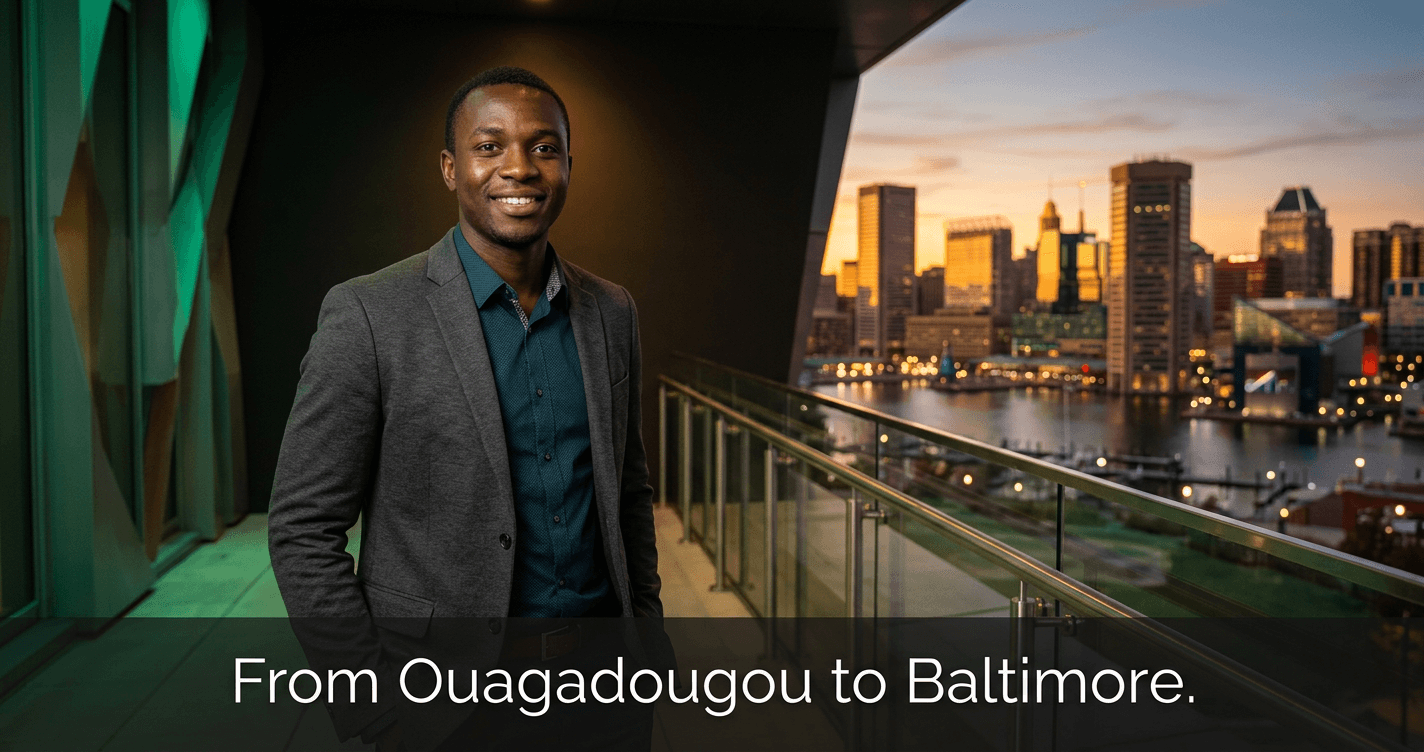
I grew up in Burkina Faso, ran a cybercafe at 14, and built an AI agency in Baltimore. Here is why.
I did not grow up around tech founders. I did not have a mentor in Silicon Valley. Nobody in my family had a startup.
I grew up in Ouagadougou, the capital of Burkina Faso, in West Africa. And the first business I ever ran was a cybercafe.
I was 14.
This is the story of how I got from there to here -- running DAKISS Media, an AI receptionist agency in Baltimore, Maryland. It is not a polished origin story. It is just the truth about why I built what I built, and why I built it the way I did.
The cybercafe
In Ouagadougou, most people did not have internet at home. If you wanted to go online, you went to a cybercafe. You paid by the hour. You sat at a shared computer. And for that hour, you had access to the entire world.
I was a teenager, and I was running one of those cafes. Setting up the machines. Troubleshooting connections. Helping people who had never touched a computer figure out how to send their first email.
Here is what I learned at 14 that I have never forgotten: technology is not impressive because it is complicated. It is impressive because it gives people access they did not have before.
A farmer checking crop prices online for the first time. A student submitting a university application. A mother video-calling her son in another country. None of them cared about bandwidth or operating systems. They cared about what the technology let them do.
That has shaped how I think about everything since. Not "what does this technology do?" but "who does it help, and what can they do now that they could not do before?"
Coming to America
I came to the United States the way a lot of immigrants do -- with a plan, some money I had saved, and a belief that hard work would be enough.
And for a while, I just worked. I did what I had to do to get established. I learned the systems, the culture, the pace. I built a life in Baltimore.
But the whole time, I was watching.
I watched the barbershop down the street from my apartment miss calls all day because the owner was cutting hair and could not get to the phone. I watched the African restaurant owner lose catering leads because nobody answered on weekends. I watched the cleaning company run by a woman from El Salvador -- who had more talent than half the businesses in the city -- get outpaced by competitors whose only real advantage was a receptionist.
These were not businesses that lacked skill or heart. They lacked tools. Specifically, the kind of tools that bigger companies take for granted -- someone to answer the phone, capture the lead, and book the appointment.
And I kept thinking the same thing I thought in Ouagadougou: technology should fix this. Directly. Obviously. "This solves your actual problem" -- that kind of fix.
The missed call problem
I did not set out to start an AI company. I set out to fix a specific problem I saw every day.
Small businesses miss calls. A lot of calls. The national average is 62%. That means for every 10 people who call a small business, 6 of them hear a voicemail. And 85% of those people never call back.
They do not leave a message. They do not try again tomorrow. They call the next business on Google.
For a contractor on a job site, that missed call might be a $3,000 project. For a salon owner with her hands in someone's hair, it might be a new regular client. For a law office running with two people, it might be a case worth tens of thousands.
And the worst part? Most of these business owners do not even know it is happening. They think business is slow. They think they need more marketing. They think they need a better website. What they actually need is for someone to answer the phone.
When I realized that AI had gotten good enough to do this -- not in a clunky, robotic way, but in a way that actually sounded like a real person -- I knew that was it. That was the problem I was going to solve.
Why I did not build a software company
I could have built an app. I could have created a platform where people sign up, configure their own AI, and figure it out themselves.
I did not.
Because I know my customers. They are the barbershop owner. The plumber. The cleaning company. The immigrant entrepreneur who is already working 14-hour days. They do not have time to sit in a dashboard and learn prompt engineering. They do not want another login. They want the problem solved.
So DAKISS Media is not a software company. It is a service. Done-for-you. We build your AI receptionist. We train it on your business. We connect it to your phone. We test it. We launch it. And we manage it.
You do not touch a thing. You go back to running your business, and your phone starts getting answered.
$197 a month. First month free. That is it.
I built it this way because I remember the people in my cybercafe. They did not want to learn how the internet worked. They wanted to send the email, check the price, make the call. The technology was only valuable because someone set it up and made it accessible.
That is what DAKISS does. We make AI accessible for people who should not have to become AI experts to benefit from it.
Baltimore, specifically
I did not build DAKISS in San Francisco or Austin or Miami. I built it in Baltimore.
Partly because this is where I live. But mostly because Baltimore is the kind of city that needs this.
Baltimore has over 14,000 small businesses. A lot of them are run by people who look like me -- immigrants, Black entrepreneurs, tradespeople, first-generation business owners. People who built something real from nothing. People who are good at what they do but do not have a corporate infrastructure behind them.
Venture capital firms are not lining up to help these businesses. Big tech companies are not building products for them. They are overlooked. And when they lose -- when they close, when they cannot compete -- it is usually not because they were not good enough. It is because they did not have the tools.
I built DAKISS to close that gap.
DAKISS was featured in VoyageBaltimore -- and that mattered to me, because it meant the city noticed. Not Silicon Valley. Not some tech conference. Baltimore.
The trust problem
I will be honest about something. A lot of the neighborhoods I work in do not trust tech companies. And they have good reason not to.
They have been sold tools that did not work. They have been talked down to by salespeople who did not understand their business. They have watched "innovation" happen around them without ever reaching them.
So when I show up and say "I have an AI that answers your phone," I understand the skepticism. I get it.
That is why DAKISS works the way it does. You talk to me. Not a sales team. Not a chatbot. Me, Ali. I sit down with you -- in person if you are in Baltimore, on a call if you are not -- and I learn your business before I build anything.
You hear the AI before you pay a dollar. Your first month is free because I want you to trust the results, not the pitch.
I am not trying to disrupt anything. I am trying to help the businesses in my community stop losing money to a problem that already has a solution.
This is why we do what we do
I think about that cybercafe all the time.
I think about the people who walked in not knowing how to use a mouse and walked out having done something that changed their day. Technology felt like magic back then -- not because it was complex, but because it opened a door that had been closed.
DAKISS Media is the same idea, just grown up.
A missed call is a closed door. And a business that cannot answer the phone loses -- not because of talent, not because of effort, but because of a gap in access that should not exist anymore.
We fill that gap. That is the whole mission.
If you are a small business owner in Maryland, DC, Virginia, or anywhere in the country -- and you are tired of losing leads to voicemail -- I want to talk to you. Not to sell you something. To listen. To understand your business. And to show you what happens when your phone never goes unanswered.
Book a free call with Ali -- your first month is on us.
DAKISS Media is an AI agency serving small businesses across Maryland, DC, and Virginia. We install AI receptionists that answer every call 24/7, book appointments, and text you every lead -- so you can focus on the work.