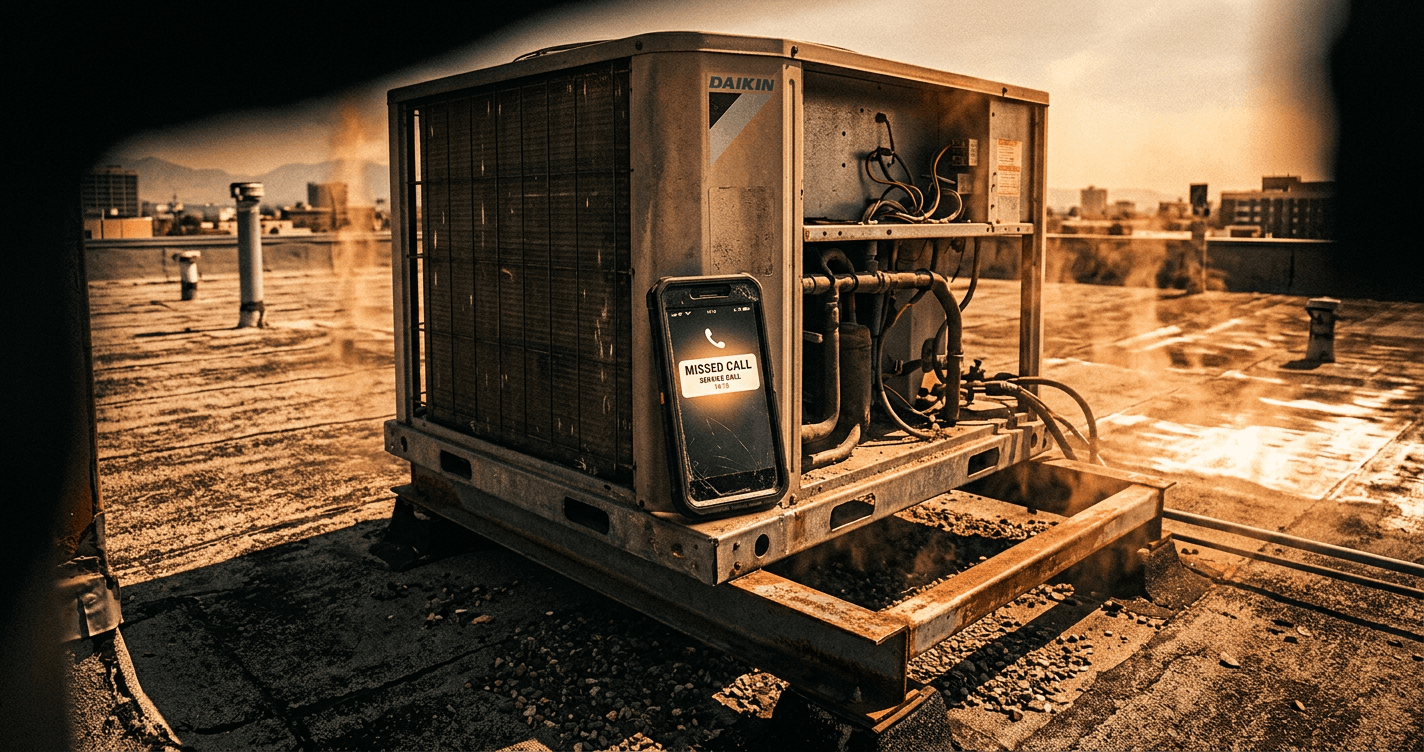
HVAC Companies: The Emergency Call at 2 AM Is Your Most Profitable Lead. Are You Answering?
It is 2:14 AM on the hottest night in July. A homeowner in Ellicott City wakes up sweating. The AC unit is dead. The thermostat reads 89 degrees inside. There are two kids sleeping down the hall.
She grabs her phone. Searches “emergency HVAC near me.” Calls the first company that shows up.
Your company.
The phone rings four times. A generic voicemail kicks in. “Thank you for calling. Our office hours are Monday through Friday, 8 AM to 5 PM. Please leave a message.”
She hangs up and calls the next company. Someone answers. They send a tech at 7 AM. That is a $1,200 emergency service call -- and it just went to your competitor.
You will never know it happened.
Peak season is when you lose the most money
HVAC is a seasonal business with two massive surges: summer cooling and winter heating. Revenue should be at its highest during these months. But your phone also rings the most during these months -- and your team is least available to answer it.
Every tech is booked. Half of them are on rooftops. The other half are in crawlspaces or attics where cell service barely exists. Your office manager -- if you even have one -- is fielding walk-ins, processing invoices, and scheduling tomorrow's routes.
The phone rings. Nobody picks up.
Industry data shows roughly 62% of service calls to small businesses go unanswered during peak hours. For HVAC, it is worse -- your call volume doubles or triples at the exact same time your team capacity maxes out.
Your busiest days are your most expensive days to miss a call.
Emergency calls are not regular calls
Here is what makes HVAC different from a lot of other trades: the emergency call is a completely different animal.
A homeowner with no AC in August is not price shopping. A family with no heat in January is not comparing three quotes. They need someone now. They are uncomfortable, they are stressed, and they will pay premium rates to get the problem fixed today.
Average HVAC service ticket: $400 to $600. Emergency call ticket: $800 to $1,500 or more.
73% of homeowners choose the first HVAC company that picks up the phone. Not the cheapest. Not the one with the best Yelp page. The one who answers.
When your phone goes to voicemail at 2 AM, you are not just missing a lead. You are missing your highest-margin work of the entire week.
The math that should bother you
Most small HVAC operations miss 6 to 8 emergency calls per week during peak season. That is not a guess -- it is what we see consistently when we run audits for HVAC companies in the DMV.
At an average emergency ticket of $800, that is $4,800 to $6,400 in missed revenue per week. Even if half of those callers would not have converted, you are still looking at $2,400 to $4,800 per month walking out the door.
Per month. During your most profitable season.
85% of callers who reach voicemail do not call back. They do not leave a message. They do not try again in the morning. They are already on the phone with the next company before your voicemail finishes its recording.
You are paying for trucks, insurance, marketing, and Google ads to make your phone ring. Then nobody answers it.
Why your techs cannot be your receptionists
You already know this, but it is worth saying out loud: your technicians cannot answer phones. It is not a laziness problem. It is a physics problem.
They are on a roof. They are in an attic where it is 140 degrees. They are in a crawlspace. They are standing in a customer's living room explaining a compressor replacement while the homeowner asks questions.
Pulling a tech off a job to answer a call costs you productivity on the current job and rarely results in a good customer experience on the call. A tech who is distracted, rushed, or out of breath from climbing down a ladder is not the voice you want representing your business.
Your techs should be doing HVAC work. The phone needs its own solution.
How the AI handles after-hours and emergency calls
An AI receptionist does not sleep, take breaks, or climb onto rooftops. It answers every call to your business, 24/7, using your company name and your specific services.
Here is how it works for HVAC specifically.
When a call comes in, the AI asks what the issue is -- no cooling, no heating, gas smell, water leak from the unit. It determines urgency based on the answers. A total system failure in July gets flagged differently than a thermostat question.
Then it qualifies the caller. Name, address, phone number, system type if known, availability. Everything your dispatcher needs to schedule a tech -- collected before anyone on your team picks up a phone.
You get a text with the full lead details. You see it when you see it. Nothing falls through the cracks.
And not every after-hours call is an emergency. The AI knows the difference between “my AC is making a noise” and “my house is 95 degrees and I have an infant.” Emergency calls get flagged for immediate follow-up. Routine calls get scheduled for the next available slot.
It works with the software you already use
If you are running ServiceTitan, the AI feeds leads directly into your dispatch board. New call comes in, it shows up in your system. Appointment booked, it hits your calendar. No double entry. No sticky notes.
Running Jobber? Same thing. The AI integrates into your existing workflow so your team does not have to learn anything new or change how they operate.
If you are not using either -- if you run your business off your phone and a clipboard -- the AI simply texts you every lead. You handle it from there.
The review flywheel
Here is the part most HVAC companies do not think about: answered calls do not just make you money today. They build your business for tomorrow.
Every answered call is a chance to book a job. Every completed job is a chance to ask for a 5-star Google review. Those reviews push your ranking up. A higher ranking means more calls coming in. And that cycle keeps compounding.
The first gear that turns the whole thing is simply answering the phone.
The HVAC companies that dominate their local market are not always the best technicians. They are the ones who pick up every call and close the loop with a review request after every job.
The numbers side by side
| Option | Monthly Cost | What You Get |
|---|---|---|
| No receptionist (current) | $0 | Missed calls, lost emergencies, no after-hours capture |
| Part-time office help | $2,000 - $3,000 | Coverage 20-30 hrs/week, no nights, weekends, or holidays |
| AI receptionist | $197/mo | 24/7 coverage, emergency triage, lead texting, software integration |
At $197 per month, one recovered emergency call pays for the entire service for two to four months. Most HVAC companies see that in the first week.
Your first month is free. Setup takes 5 days. You do not configure anything -- we build the entire system for you.
Your techs are great. Your phone system is not.
You did not start an HVAC company because you love answering phones. You started it because you know how to keep people comfortable in their homes. Your work is solid. Your techs know what they are doing.
But the homeowner at 2 AM does not know any of that. She only knows that she called and nobody picked up. So she called someone else.
73% of homeowners hire the first company that answers. With an AI receptionist, that company is always yours -- even during a July heat wave when every tech is booked and every line should be ringing off the hook.
Find out exactly how many emergency calls your HVAC company is missing -- and what they are costing you. We built a Revenue Audit specifically for HVAC. It takes 30 seconds.
Run your free HVAC Revenue Audit -->
Want to talk through it instead?
DAKISS Media is an AI agency serving small businesses across Maryland, DC, and Virginia. We install AI receptionists that answer every call 24/7, book appointments, and text you every lead -- so you can focus on the work.